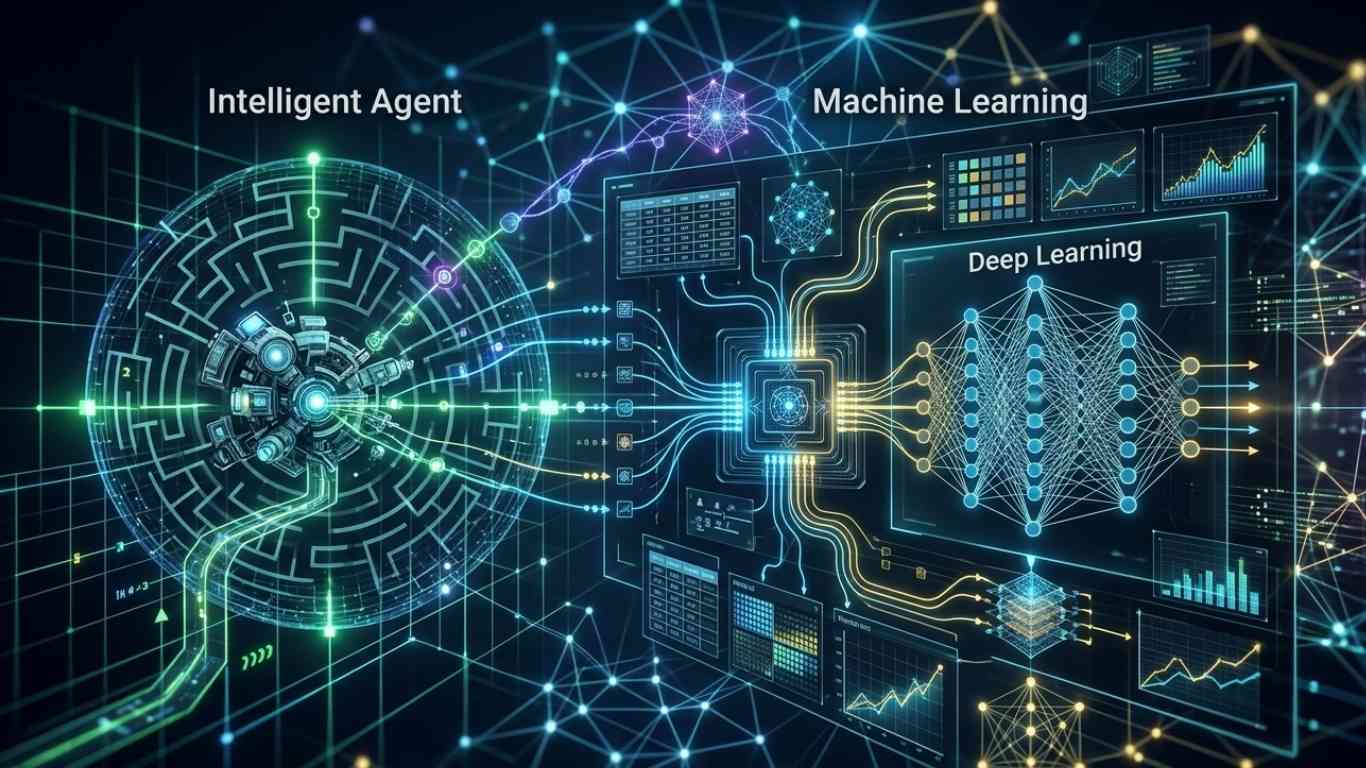
Intelligent agent vs machine learning vs deep learning: key differences is one of the most commonly misunderstood areas in AI. These terms are related, but they do not describe the same level of capability.
If the vocabulary is unclear, the whole field feels confusing. Once the distinctions are clean, AI becomes much easier to understand and apply.
First, separate the layers
Artificial intelligence is the umbrella concept. Machine learning sits inside AI. Deep learning sits inside machine learning. Intelligent agents are systems that use perception, reasoning, and action to pursue goals.
The easiest way to understand this is to separate learning from acting. Machine learning and deep learning are mostly about learning patterns from data. Intelligent agents are about deciding what to do next.
Quick comparison
| Concept | Core Role | Main Idea | Example |
|---|---|---|---|
| Artificial Intelligence | Broad field | Machines perform intelligent tasks | Virtual assistant |
| Machine Learning | Learning from data | Model improves through examples | Spam filter |
| Deep Learning | Advanced pattern learning | Neural networks detect complex relationships | Face recognition |
| Intelligent Agent | Goal-directed action | System observes, decides, and acts | Task-executing assistant |
Machine learning in plain terms
Machine learning allows a system to detect patterns from examples rather than relying only on fixed human-written rules.
If you feed a model thousands of labeled emails, it can learn to identify which ones are likely spam. It does not “understand” email the way a person does, but it learns a useful pattern.
Deep learning is not just bigger machine learning
Deep learning is a specialized form of machine learning built on layered neural networks. It becomes especially powerful when the data is large and the patterns are complex.
This is why deep learning dominates image recognition, speech systems, and many language applications. It is good at extracting signal from complicated input, but it usually requires more data, more computation, and more tuning.
So what makes an intelligent agent different?
An intelligent agent is not defined only by how it learns. It is defined by how it behaves.
It observes an environment, interprets information, chooses an action, and moves toward a goal. A planning assistant that reads a request, selects tools, checks memory, retrieves information, and completes a task behaves like an intelligent agent.
This is the part many explanations skip. Intelligent agent vs machine learning vs deep learning: key differences becomes much clearer when you realize that an agent is action-oriented, while learning models are often prediction-oriented.
Why the distinction matters in real work
A company does not always need an intelligent agent. Sometimes a classifier is enough.
A product team may only need a recommendation engine, a fraud detector, or a document classifier. In those cases, machine learning may solve the problem cleanly. An intelligent agent only makes sense when the system must decide, sequence actions, and respond dynamically.
Conclusion
Intelligent agent vs machine learning vs deep learning: key differences matters because each term points to a different job. Machine learning learns from data, deep learning handles more complex representations, and intelligent agents use intelligence to make decisions and act toward objectives.
Also Read: How to Use NotebookLM for research


Leave a Reply