
Imagine you access your broadband network within a 100-150 metre range from the nearest fibre node in your home. But beyond that range, it fails to catch signals. And if that coverage expands over 4000 square feet, you can access your phone, tablet, or even your laptop anywhere in that area. This is called a cloud-based system. Interestingly, over 70% of enterprises will use specialised industry cloud platforms according to their niche, like healthcare or finance, which results in a massive shift from 15% in 2023 (source).
What Exactly Is the “Cloud”?
The cloud is related to IT, which is considered a giant space filled with thousands of extremely powerful computers, also called servers. So, IT cloud solutions refer to effectively handling that giant space connected with servers.
A cloud is like a giant space where millions of datasets are shared over the internet to keep them saved. These spaces are called data centers. Amazon, Google, and Microsoft are some of the giants that host these centers, which diverse companies use as a premium service. So, these data centers are typically rented out to companies or users who claim a tiny piece of those massive computers at a cost.
How Does It Work?
Let’s understand a cloud-based system via this example.
- On-Premise: An on-premise cloud is like making pizza at home, which needs you to buy the oven, the flour, the cheese, and the toppings with seasonings. You can make it until the oven breaks down. Moreover, it serves up to a certain limit. If its limit is crossed, it won’t fulfil the requirement. In the same way, on-premises cloud has its defined territory of service.
- The Cloud: The cloud is a service provider. A company or a person does not need to buy the cloud but procures a part that fits specific demands from vendors like Google, Microsoft, or Amazon. The provider hosts backend services like fittings and fixtures, IT infrastructure, computers, hardware, and configuration under a “pay-as-you-go” model. Many businesses also focus on AWS cloud cost optimization to reduce unnecessary spending and efficiently manage cloud resources while scaling operations.
In the digital world, when a company decides to migrate to cloud-based services, it basically wants not to buy or fix its own heavy computer servers. Rather, it orders vendors to power its computers by providing the space to save and work with data from the cloud.
The Three Main “Layers” of the Cloud
Technically, three main types of cloud systems are dominating.
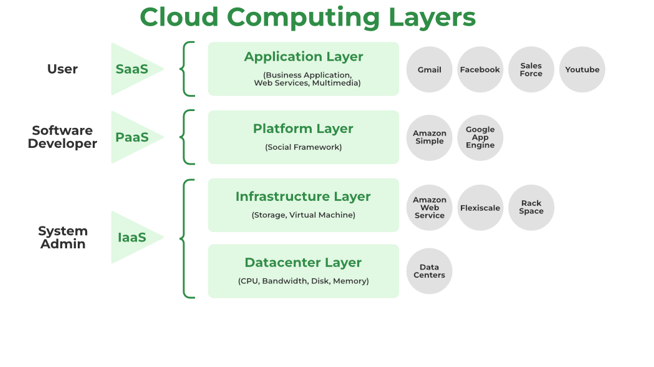
- SaaS (Software as a Service): Software as a Service is the most popular service. Apps like Gmail, Netflix, or Roblox use SaaS, which means they don’t see the code or how it works; instead, they just log in and use the service.
- PaaS (Platform as a Service): This is for websites, software, and application developers. It’s like a digital space where developers access necessary tools seamlessly to build their own software, websites, or applications without worrying about technical things that they work with.
- IaaS (Infrastructure as a Service): This is the most significant service, which is to rent out an IT infrastructure. It covers everything from the property, electricity, security, systems, and their configurations. Simply put, vendors rent the raw power of the servers and allow users to build whatever they want from scratch.
Why Do We Use It?
Many companies and users often ask, “Why don’t we keep everything on our own computers?” Well, there are three big reasons behind it:
Scalability (The “Elastic” Factor): Imagine Google Gemini launches a big new update. Suddenly, millions of people logged in at the same time to leverage it. If they use an old version without that feature, the server will melt. On the flip side, the cloud provides flexible services. It can automatically grow to handle millions of requests and then ramp down when the requests are normal.
Reliability: Can you recover in-device photos when your mobile phone breaks down? Certainly, it’s not possible unless you have saved them in the cloud. The photos remain safe and are saved permanently in that big data center. So, no matter if one server does not work. There are thousands of others that keep backups ready to retrieve data.
Cost: Cloud services cost a lot in the beginning. But they are way cheaper to rent a tiny bit of a giant computer than to buy a whole expensive local server whose maintenance costs become unbearable in the long term.
What Does a Cloud Engineer Actually Do?
A cloud engineer acts like a digital architect. This professional does everything from designing to automating data pipelines.
Designing: The cloud engineer drafts data pipelines from scratch, enabling how data should move. He ideates how to get a photo, for example, from a user in India to a server in the USA in less than a second.
Migration: His/her core function is to support companies in migrating data to cloud-based services. It’s like a hustle involved in shifting a house with all furniture, clothes, and kitchen items into a new and better house without breaking or losing the keys.
Security: His or her role is non-negotiable in fortifying digital assets and keeping hackers out. As the cloud is accessible from anywhere, he or she must be extra careful about who has the key to getting into the cloud environment.
Automation: Codifying to guide the computers about how to fix themself is also included in his or her core. If a server gets overwhelmed, the code notifies a new server to wake up and administer the request.
Conclusion
Think of a voice assistant like Siri. While following the guideline, it uses a cloud-based system. Its engine runs the modern world. So, if you like solving puzzles, building things, and wondering how the internet answers everything, diving deep into the profile of a cloud engineer can help. Simply put, cloud engineering refers to building the invisible infrastructure that connects the whole planet.
Overall, a cloud-based platform is like a whole information world in a place. So, whenever you save or access data by using any device, your data goes on a trip to a high-tech fortress filled with servers. These are the places where cloud engineers ensure that your data remains safe, fast, and always ready to use.




Leave a Reply