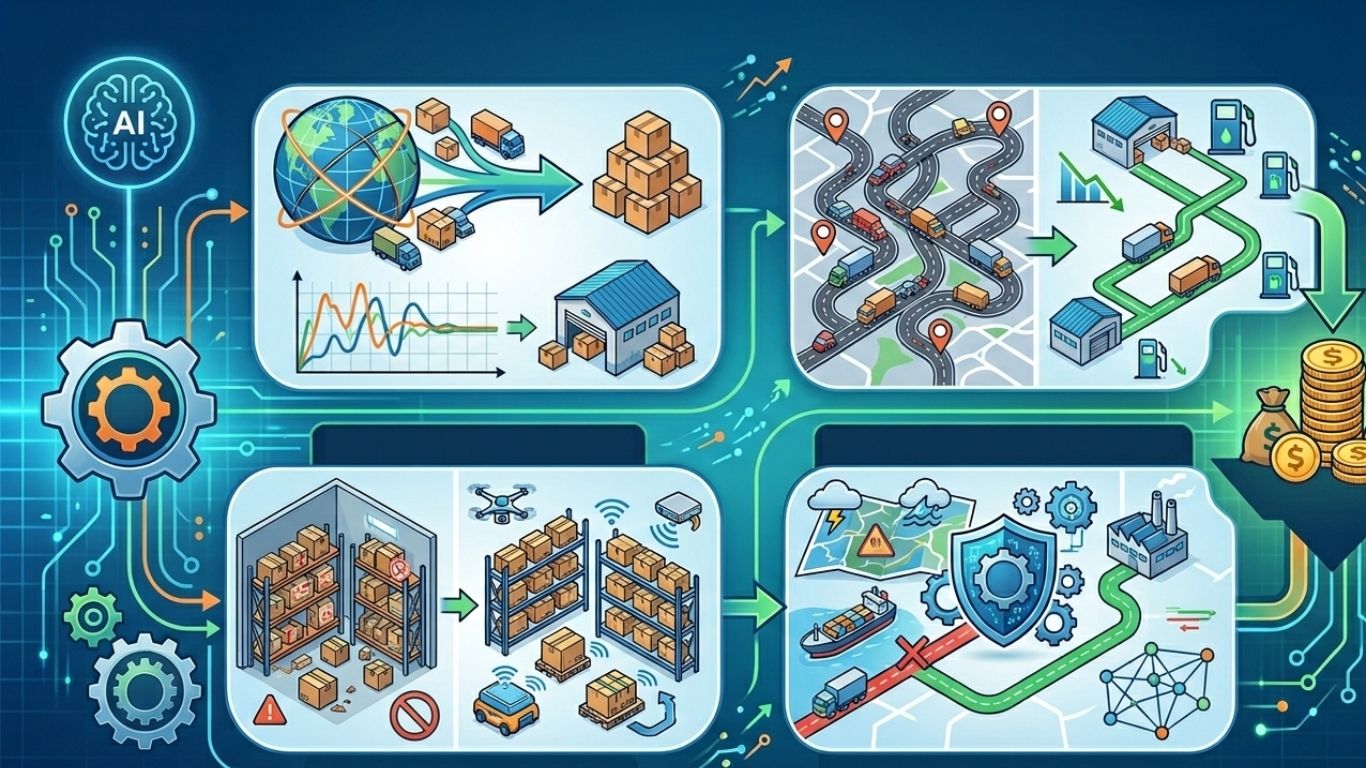
Supply chain costs continue to rise as businesses deal with demand volatility, excess inventory, transportation inefficiencies, supplier disruptions, and labor pressure. The scale of that burden is hard to ignore. According to the Council of Supply Chain Management Professionals (CSCMP), U.S. business logistics costs total $2.3 trillion, equal to 8.7% of U.S. GDP. That figure shows how deeply supply chain expenses affect business performance.
That is one reason AI is becoming more important in supply chain management. Businesses are using AI to improve demand forecasting, optimize inventory levels, support better procurement decisions, reduce warehouse inefficiencies, and improve logistics planning. The goal is practical. AI helps companies reduce waste, improve responsiveness, and make better operating decisions based on real supply chain data.
This article explains practical ways businesses use AI to reduce costs across supply chain operations.
What Does AI Mean in Supply Chain Management?
Artificial intelligence in supply chain management means using systems that can analyze data, detect patterns, predict outcomes, and support better decisions. In simple terms, AI helps businesses manage supply chain operations with greater accuracy, speed, and control.
Instead of relying only on manual planning or fixed rules, AI can process large volumes of real-time and historical data from across the supply chain. That includes sales patterns, inventory levels, supplier performance, shipment status, warehouse activity, and equipment data. This helps businesses improve visibility, respond faster to change, and make better operational decisions.
How AI Reduces Costs in Supply Chain Management?
AI reduces costs in supply chain management by helping businesses improve forecasting, control inventory, reduce logistics waste, optimize labor, and make better operational decisions. Below are the main ways businesses use AI to reduce supply chain costs in practice.
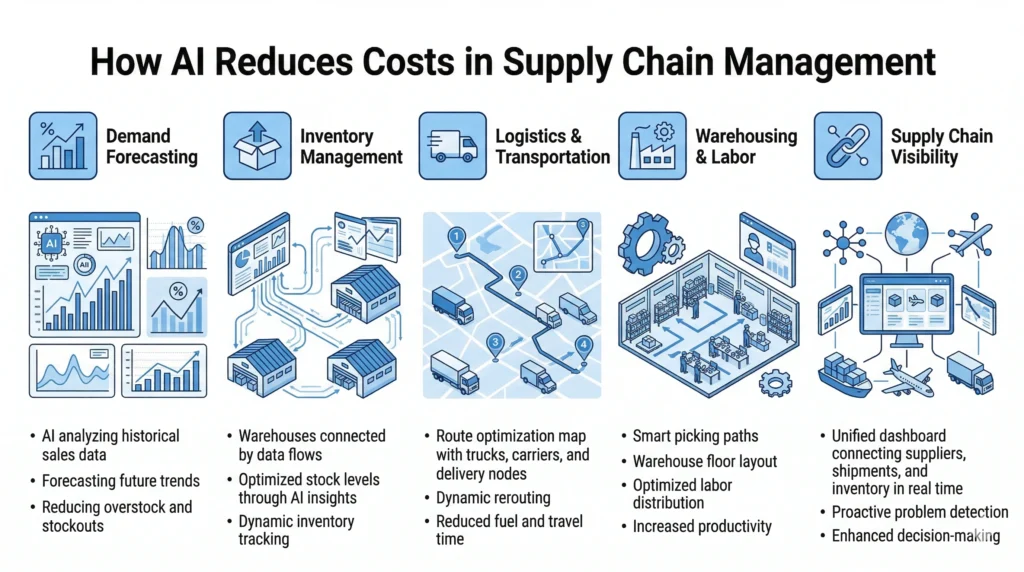
1. AI-Powered Demand Forecasting Reduces Costly Planning Errors
Inaccurate forecasting is one of the most common reasons supply chain costs rise. When demand is overestimated, businesses buy or produce too much inventory. That increases storage costs, ties up working capital, and raises the risk of obsolete stock or excess MRO inventory. When demand is underestimated, businesses face stockouts, missed sales, delayed orders, and urgent replenishment that often drives up freight and rush shipping costs.
AI-powered supply chain optimization helps reduce these problems by improving forecast accuracy. AI models can analyze historical sales, seasonal patterns, customer behavior, promotional activity, regional demand shifts, and other demand signals more effectively than manual planning alone. This gives supply chain teams a clearer view of expected demand and helps them make adjustments earlier.
The cost impact is clear. Better forecasting helps businesses reduce excess inventory, avoid lost sales, lower emergency shipping costs, and improve inventory planning across locations. In practical terms, that means less cash tied up in slow-moving stock and fewer expensive reactions when demand changes unexpectedly.
Practical Industry Example:
SAP reports that SLB improved demand forecast accuracy in some business lines from less than 50% to around 90% within 6 to 9 months after implementing SAP Integrated Business Planning. The company also drove more than $1 billion in inventory savings over four years and reduced days inventory outstanding by 37% over three years.
2. AI Improves Inventory Management and Lowers Carrying Costs
Inventory costs rise quickly when businesses hold too much stock or place inventory in the wrong locations. Excess inventory increases storage costs, ties up working capital, and raises the risk of dead stock that moves slowly or no longer aligns with demand. Poor inventory planning can also leave critical items unavailable when they are needed most.
AI helps businesses maintain optimal inventory levels by leveraging real-time and historical data to improve replenishment and stock planning. Instead of relying on static reorder points or fixed planning rules, teams can use AI to adjust inventory decisions based on demand patterns, supplier lead times, order variability, and item movement. This helps reduce unnecessary stock without increasing the risk of stockouts.
AI also supports better safety stock optimization and inventory visibility. It can identify where buffer stock is too high, too low, and where inventory is accumulating without clear demand. With better visibility across warehouses and distribution networks, businesses can reduce storage costs, free up working capital, and make faster decisions about replenishment, transfers, and slow-moving inventory.
Practical Industry Example:
Amplio uses AI agents to connect across ERP systems and analyze inventory data from multiple sites. The platform identifies idle or underutilized assets, forecasts internal demand, and classifies items for redeployment or liquidation. This helps enterprises reduce carrying costs, improve visibility into slow-moving inventory, and convert surplus industrial stock into working capital.
3. AI Cuts Logistics and Transportation Costs
Logistics costs rise when routes are inefficient, carrier choices are weak, loads are underutilized, or deliveries are scheduled poorly. These problems increase freight spend, fuel use, delays, and service issues across the supply chain.
AI-powered supply chain optimization helps reduce these costs by improving transport decisions across the network. It can analyze shipping patterns, transit times, carrier performance, order priority, and network constraints faster than manual planning alone. This helps businesses plan routes more effectively, improve load utilization, select better carrier options, and coordinate deliveries with greater accuracy.
Businesses can reduce empty miles, lower fuel waste, improve freight efficiency, and avoid delays that increase transportation spend. Better coordination across carriers, warehouses, and delivery schedules also helps improve service reliability while reducing avoidable logistics costs.
Practical Industry Example:
Emerson used Oracle Transportation Management to improve carrier selection, freight visibility, and load consolidation across its supply chain. Oracle reports that the company used the platform to improve on-time delivery, consolidate freight more effectively, and reroute shipments faster during disruptions.
4. AI in Warehousing Helps Reduce Labor and Operational Costs
Warehouse costs rise when slotting is inefficient, picking paths are longer than necessary, or labor is not aligned with the actual workload. These problems slow fulfillment, increase handling time, and create avoidable labor waste across warehouse operations.
AI helps improve warehouse performance by making slotting and picking more precise. It can analyze order patterns, product movement, pick frequency, and storage constraints to place inventory in better locations and reduce unnecessary travel time. It can also improve picking efficiency by helping teams prioritize tasks, sequence work more effectively, and process orders faster.
AI also helps optimize labor distribution across locations. Analyzing order volume, staffing levels, shift patterns, and fulfillment demand, it can help businesses assign labor where it is needed most across warehouses, distribution centers, and fulfillment sites. This reduces labor waste, improves fulfillment speed, and helps control warehouse operating costs without sacrificing service levels.
Practical Industry Example:
DSC Logistics used Blue Yonder’s warehouse labor management tools to improve workforce planning and execution across its logistics network. Blue Yonder says the company achieved a 20% reduction in variable labor spend across 50 distribution centers.
5. AI Improves Supply Chain Visibility and Faster Decision-Making
Supply chain costs often rise when data is fragmented across systems, teams, and locations. When inventory, supplier updates, shipment status, and warehouse activity sit in separate tools, businesses respond more slowly and make decisions with incomplete information. That can lead to excess inventory, missed delays, rushed orders, poor coordination, and avoidable operating costs.
AI helps solve this by creating a clearer operating view across the supply chain. It can connect data from inventory systems, supplier records, transportation updates, and warehouse operations to detect patterns, flag risks, and surface issues earlier. This gives teams a more complete view of suppliers, shipments, stock levels, and fulfillment activity.
This is one of the most practical benefits of AI in the supply chain. Better visibility helps businesses make faster decisions, improve coordination across functions, and reduce the need for costly reactive action. In cost terms, that means less waste, fewer disruptions, and stronger control across day-to-day supply chain operations.
Practical Industry Example:
Bel Fuse used Microsoft Dynamics 365 Supply Chain Management to unify data and improve visibility across its global supply chain. The platform helped the company track sales orders, purchase orders, supplier delays, and factory production in one connected system. This gave teams a clearer operating view and helped them respond faster when parts arrived late or when supplier conditions changed.
Conclusion
AI reduces supply chain costs by helping businesses make better decisions, reduce waste, and improve operational efficiency. From demand forecasting and inventory management to logistics, warehousing, and supply chain visibility, the value comes from using better data to make smarter and faster supply chain decisions.
The biggest benefit is not automation by itself. It is stronger control over the cost drivers that affect margins every day, including excess inventory, freight inefficiencies, labor waste, and slow operational response. When applied to the right use cases, AI can help businesses improve service levels while keeping supply chain costs under better control.
The best way to start is with focus. Companies should begin with one real cost problem, measure the results clearly, and scale only after the impact is proven.




Leave a Reply