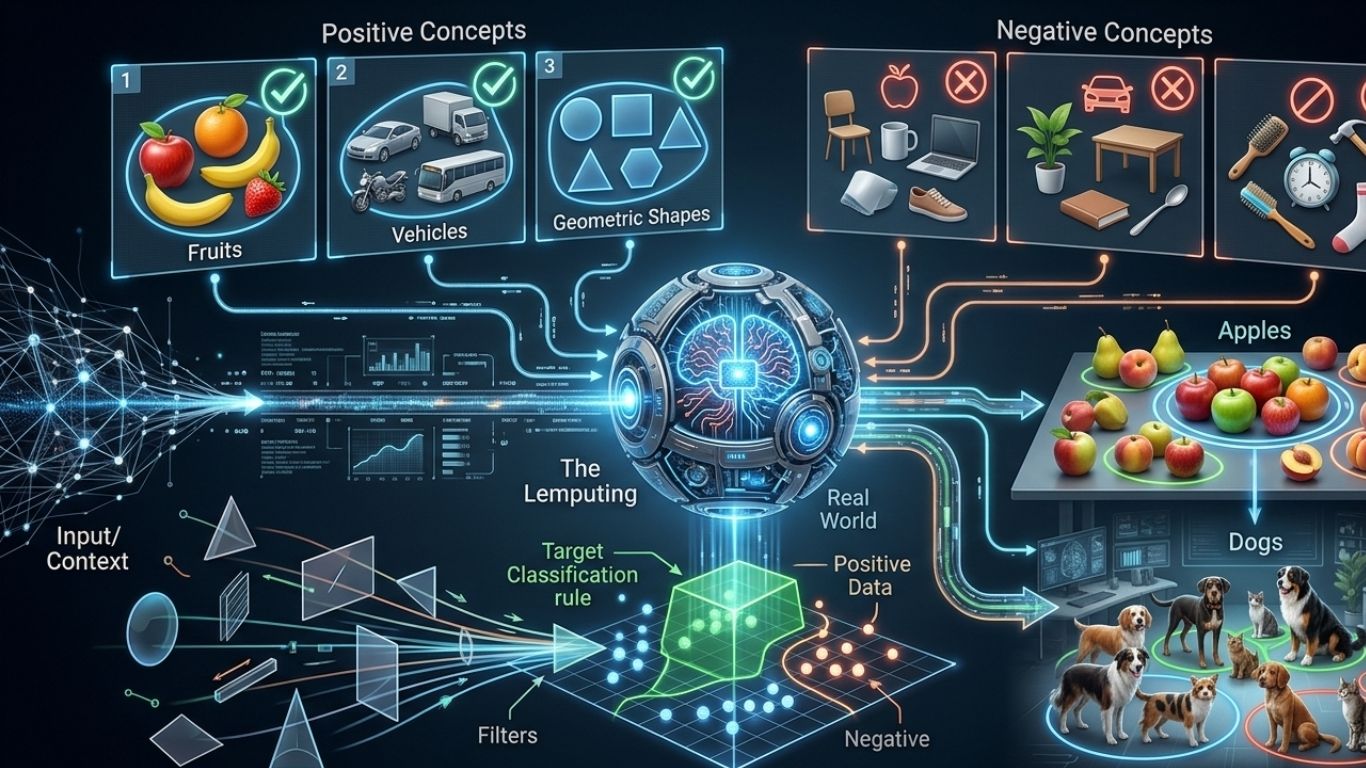
Concept learning in machine learning is the process of teaching a model to identify whether something belongs to a category based on examples. In simple words, the system learns a concept such as “spam email,” “approved loan,” or “fraudulent transaction” by studying labeled data and finding patterns that separate positive and negative cases.
This matters because many practical machine learning systems depend on clear decision boundaries. If a model can learn a concept accurately, it can classify new data with better confidence and consistency. That is why concept learning in machine learning is one of the foundational ideas behind classification tasks.
How concept learning works
A concept is usually defined as a target class the model needs to recognize. The algorithm receives training examples with labels and tries to infer the rule behind them. For example, if a model sees many emails marked as spam and non-spam, it starts learning which words, links, or structures signal spam.
The goal is not to memorize every example. The goal is to discover a general rule that works on unseen data too. This is why training data quality matters so much. If the examples are noisy, biased, or incomplete, the learned concept may be weak.
Main elements involved in concept learning
| Element | Meaning | Example |
|---|---|---|
| Instances | Individual data points | One email, one customer record |
| Attributes | Features of each instance | Word count, sender name, income |
| Target concept | The category to learn | Spam or not spam |
| Hypothesis | A possible rule learned by the model | “Emails with suspicious links are spam” |
Why concept learning is important
Concept learning helps convert raw data into usable decisions. It supports tasks like medical diagnosis, document classification, fraud detection, and recommendation systems. In all these cases, the model must learn what belongs to a class and what does not.
It also helps explain how machine learning systems move from examples to predictions. Even in advanced models, the core idea stays the same: learn from past patterns, then apply that learning to new cases.
Examples of concept learning in real life
A bank can use concept learning to decide whether a loan application is risky. A hospital can use it to classify whether a patient record suggests a disease. An eCommerce store can use it to detect whether a review is fake.
In each case, the system is learning a concept from examples. It compares input features, finds useful patterns, and uses them to make future classifications.
Challenges in concept learning
Concept learning is powerful, but it is not perfect. If the training data is too small, the model may fail to learn the true pattern. If the data contains irrelevant features, the model may focus on the wrong signals. If the concept changes over time, the model may become outdated.
Another challenge is overfitting. This happens when the model learns the training examples too closely and performs poorly on new data. Good concept learning in machine learning depends on both relevant features and enough diverse examples.
Final thoughts
Concept learning in machine learning is about learning categories from examples. It gives models the ability to make structured decisions instead of random guesses. When the data is clean and the concept is well defined, concept learning becomes a reliable base for accurate classification systems.
Read> AI APP Development Guide





Leave a Reply