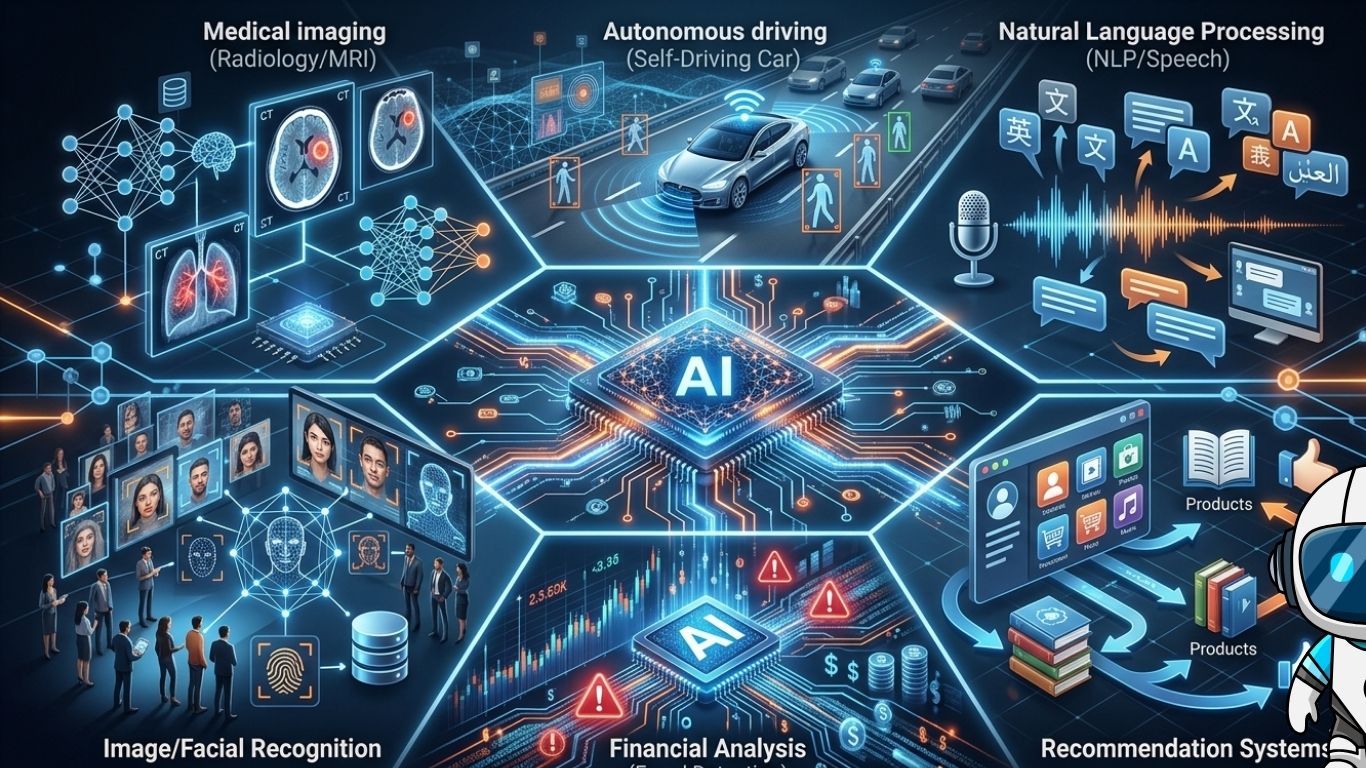
If you want a practical answer to which are common applications of deep learning in artificial intelligence, you need to look at where machines handle images, language, sound, patterns, and predictions at scale.
Deep learning gives AI the power to learn from large volumes of data. It uses layered neural networks to find hidden patterns and make decisions with less manual rule-writing.
For you, this means faster automation, smarter products, better customer experiences, and more accurate predictions across many industries.
What Deep Learning Actually Does in AI
Deep learning helps machines recognize complex patterns in data. Traditional machine learning often depends on manual feature selection, but deep learning learns many of those features on its own.
That is why it performs so well in tasks like image recognition, speech processing, language generation, fraud detection, and recommendation systems.
It is especially useful when the data is large, unstructured, and constantly growing.
Why Deep Learning Matters Today
You interact with deep learning more often than you may realize. Every time you unlock your phone with your face, get movie recommendations, use voice search, or translate text online, deep learning is usually involved.
Businesses use it because it improves speed, scale, and accuracy. It also helps teams automate work that once needed human review.
Main Applications at a Glance
| Application Area | What Deep Learning Does | Common Real-World Use |
|---|---|---|
| Computer Vision | Identifies objects, faces, defects, and scenes | Facial recognition, medical scans, quality control |
| Natural Language Processing | Understands and generates text | Chatbots, translation, summarization |
| Speech Recognition | Converts voice into text or actions | Voice assistants, call centers, dictation |
| Recommendation Systems | Predicts user interests | Netflix, YouTube, eCommerce suggestions |
| Healthcare Analytics | Detects patterns in patient data | Disease prediction, diagnosis support |
| Finance and Fraud Detection | Spots unusual behavior in transactions | Fraud alerts, credit scoring |
| Autonomous Systems | Interprets surroundings and reacts | Self-driving vehicles, robotics |
| Cybersecurity | Detects threats and anomalies | Spam filtering, malware detection |
Computer Vision
Computer vision is one of the strongest and most common uses of deep learning. It allows machines to interpret images and videos with impressive accuracy.
AI systems can detect faces, read handwriting, classify objects, and inspect products on factory lines. In healthcare, doctors use deep learning models to analyze X-rays, MRIs, and CT scans.
If your work involves visual data, this is one of the most valuable applications you should understand first.
Natural Language Processing
Deep learning plays a major role in language-based AI. It helps systems understand text, generate responses, detect sentiment, and translate between languages.
This is the technology behind chatbots, virtual assistants, search engines, grammar tools, and AI writing platforms. It also powers document summarization and question-answering systems.
In simple terms, it helps machines work with human language more naturally.
Speech Recognition and Voice AI
Voice-based AI depends heavily on deep learning. It converts spoken language into text and helps systems understand tone, accents, and context.
That is why tools like Siri, Google Assistant, and smart call center bots work so well. Businesses also use this technology for live transcription, accessibility tools, and voice commands.
If you want hands-free interaction in an AI product, deep learning is usually the engine behind it.
Recommendation Systems
Recommendation engines are another major application. These systems learn from user behavior, purchase history, watch time, clicks, and preferences.
Streaming platforms recommend movies. Online stores suggest products. Social apps show content you are likely to engage with.
This is a direct business win because better recommendations often improve retention, conversions, and customer satisfaction.
Healthcare and Medical Diagnosis
Deep learning helps medical teams detect patterns in patient records, scans, and lab results. It supports faster diagnosis and more accurate risk prediction.
Hospitals use it for tumor detection, disease classification, drug discovery, and patient monitoring. It does not replace doctors, but it can support better decision-making.
For healthcare organizations, this makes AI more practical and more scalable.
Finance and Fraud Detection
Banks and financial platforms use deep learning to detect fraud, assess risk, and automate decisions. These models can find suspicious behavior that traditional systems may miss.
For example, they can flag unusual transactions, identify money laundering patterns, or improve loan approval models.
If you manage payments, credit, or digital banking products, this use case has direct business value.
Self-Driving Cars and Robotics
Autonomous systems rely on deep learning to understand roads, objects, traffic signs, people, and movement in real time.
Robots use similar models to navigate spaces, pick items, inspect equipment, and perform repetitive tasks.
At this point, it becomes easier to answer which are common applications of deep learning in artificial intelligence because you can clearly see how vision, motion, and decision-making come together in real-world systems.
Cybersecurity and Threat Detection
Deep learning also strengthens cybersecurity. It helps systems detect spam, phishing, malware, and abnormal network behavior.
Instead of waiting for fixed rules, modern AI security tools learn from patterns and improve over time. That gives companies a better chance to stop attacks early.
For growing businesses, this can reduce loss, downtime, and reputational damage.
Marketing, Sales, and Customer Experience
Deep learning improves personalization in digital marketing. It helps businesses predict user intent, segment audiences, and recommend the right message at the right time.
It also improves customer support through AI chatbots, automated responses, and smart ticket routing.
If your goal is growth, deep learning helps you create a more relevant and more responsive customer journey.
Benefits and Limits of Deep Learning
| Strengths | Limits |
|---|---|
| Handles large and complex data well | Needs large datasets for best results |
| Learns features automatically | Can require high computing power |
| Delivers strong performance in vision and language tasks | Often works like a black box |
| Improves with more data and training | Can inherit bias from training data |
| Supports automation at scale | Model training can be costly and time-consuming |
Challenges You Should Know
Deep learning is powerful, but it is not perfect. It often needs huge amounts of data, strong hardware, and careful training.
It can also be difficult to explain why a model made a specific decision. That becomes important in healthcare, finance, and law, where transparency matters.
You should see deep learning as a powerful tool, not a magic solution.
The Future of Deep Learning in AI
Deep learning will continue to expand into every major sector. You will see more multimodal systems that understand text, images, audio, and video together.
You will also see smaller, faster models running on phones, edge devices, and business software. That will make AI more accessible and more useful in daily operations.
The biggest shift is simple: deep learning is moving from research labs into everyday products and workflows.
Final Takeaway
For anyone trying to understand which are common applications of deep learning in artificial intelligence, the answer is clear: it powers computer vision, language tools, voice systems, recommendations, healthcare solutions, fraud detection, robotics, and cybersecurity.
These are not future-only use cases. They are already shaping how you work, shop, communicate, learn, and make decisions.




Leave a Reply