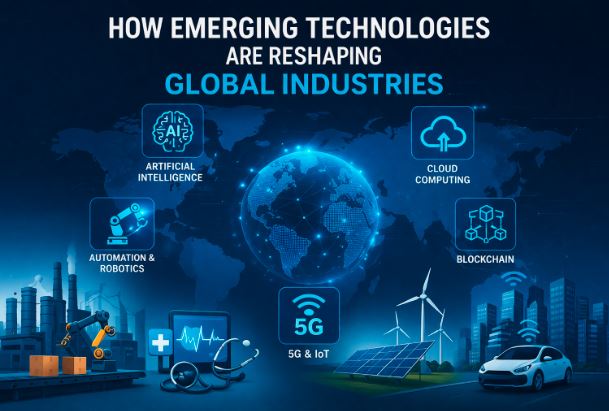
In an era defined by rapid digital transformation, emerging technologies are not just incremental improvements, they are fundamentally rewriting the rules of global industries. From artificial intelligence (AI) and the Internet of Things (IoT) to 5G connectivity, blockchain, robotics, and nanotechnology, these innovations are driving unprecedented efficiency, sustainability, and competitiveness. According to industry analyses from Expert Market Research, markets across sectors are experiencing accelerated growth fueled by these technologies, with projections extending well into the 2030s.
Consider the built environment as a microcosm of this shift. Modern commercial and residential projects increasingly integrate smart systems that optimize energy use, enhance occupant comfort, and reduce environmental impact. The Central Air Conditioning Market, for instance, is projected to grow at a robust 6.70% CAGR from 2026 to 2035. This expansion is driven not only by rising commercial construction and changing climates but also by the integration of AI and IoT for energy-efficient, smart HVAC solutions. What was once a static infrastructure component is now a dynamic, data-driven system capable of predictive maintenance and real-time optimization.
This article explores how these technologies are reshaping key global industries, drawing on insights from Expert Market Research reports and featured analyses. We’ll examine the core technologies, their sector-specific applications, real-world impacts, challenges, and the broader implications for businesses and economies worldwide.
The Core Emerging Technologies Fueling Change
At the heart of industrial transformation lie several interconnected technologies.
Artificial Intelligence and Machine Learning
AI and ML enable machines to learn from data, predict outcomes, and automate complex decisions. In 2025, AI adoption has surged across sectors, powering everything from predictive analytics to autonomous operations. Expert Market Research highlights AI’s role in virtual laboratories, where simulations accelerate drug discovery and scientific research by reducing physical experimentation needs. These AI-driven tools are transforming healthcare, biotechnology, and pharmaceuticals by cutting R&D timelines and costs while improving accuracy.
Internet of Things (IoT) and 5G Connectivity
IoT connects billions of devices, generating vast data streams for real-time insights. However, traditional networks often have limited scalability due to latency and bandwidth constraints. Enter 5G: with near-zero latency, ultra-high speeds, and massive device capacity, it unlocks IoT’s full potential. As detailed in Expert Market Research’s analysis, 5G enables edge computing processing data closer to the source for instant decision-making in manufacturing, logistics, and smart cities. This synergy supports AI applications like predictive maintenance and energy regulation, turning isolated pilots into enterprise-wide ecosystems.
Blockchain and Distributed Ledger Technology
Blockchain ensures secure, transparent transactions without intermediaries. It’s revolutionizing supply chains, finance, and even smart ports, where it tracks shipments immutably. Markets like the global supply chain management software sector are incorporating blockchain alongside AI and IoT to enhance traceability and reduce fraud.
Robotics, Automation, and Modular Systems
From collaborative robots (cobots) in factories to modular robotics in warehouses, automation is addressing labor shortages and boosting precision. The modular robotics market is expected to grow at 13.80% CAGR through 2035, per Expert Market Research. Drones and sensors further enhance safety and efficiency.
Nanotechnology and Advanced Materials
At the atomic scale, nanotechnology is creating stronger, lighter, and more efficient materials. The market is projected to reach USD 5.03 Billion by 2035 at a 10.00% CAGR, with applications in electronics, energy, aerospace, and healthcare.
These technologies rarely operate in isolation; their convergence AI + IoT + 5G, for example creates exponential effects.
Manufacturing: The Dawn of Industry 4.0 and Smart Factories
Manufacturing has undergone the most visible overhaul. Smart factories leverage IoT sensors, AI analytics, and 5G for real-time monitoring. Production lines now self-optimize, with robots handling repetitive tasks and predictive algorithms forecasting equipment failures before they occur. This reduces downtime by up to 50% in leading implementations and minimizes waste.
Expert Market Research notes that robotic sensors and automation are surging due to Industry 4.0 investments, defense needs, and supply chain streamlining. In base metal mining, enterprise AI and automation improve safety, sustainability, and output, which is critical as global demand for raw materials continues to grow
Challenges include high upfront costs and cybersecurity risks, but the ROI is clear: higher productivity, lower energy consumption, and customizable production at scale.
Healthcare and Life Sciences: Precision, Personalization, and Virtual Innovation
Healthcare is being redefined by AI-driven diagnostics, telemedicine, and virtual labs. AI-powered virtual laboratories, as explored by Expert Market Research, simulate complex biological processes, enabling faster drug development and reducing reliance on animal testing. In 2025, platforms using multi-omics data and virtual patient models are accelerating breakthroughs in oncology and personalized medicine.
IoT wearables and 5G-enabled remote monitoring allow continuous patient tracking, while blockchain secures electronic health records. The result? Improved outcomes, reduced costs, and greater access in underserved regions. Regulatory shifts, like the FDA’s move away from mandatory animal testing, underscore this tech-led evolution.
Construction: Sustainability Meets Digital Precision
The construction industry, traditionally slow to adopt change, is now at the forefront of tech integration. Building Information Modeling (BIM) creates digital twins of projects, allowing stakeholders to collaborate in real time and catch errors pre-construction. Robotics automate bricklaying and material handling, while drones conduct site surveys efficiently.
Sustainability is a major driver. Governments enforce stricter codes for energy efficiency and low-carbon materials. Smart energy management systems, cloud-based project tools, and data analytics optimize resource use and reduce waste. Prefabrication and modular construction cut timelines and environmental footprints.
This transformation directly impacts related sectors like HVAC. Smart buildings use IoT sensors and AI to regulate temperature dynamically, slashing energy bills. The Central Air Conditioning Market exemplifies this: demand for energy-efficient split, packaged, and rooftop systems is rising, especially in commercial applications across North America, Europe, and Asia Pacific. Leading players like Daikin, Carrier, and Lennox are embedding AI and IoT for smart-home compatibility and predictive performance.
Energy and Utilities: Toward a Greener, Smarter Grid
The energy sector is pivoting to renewables and efficiency. Green hydrogen is emerging as a game-changer for heavy industries, enabling decarbonization where electrification falls short. Expert Market Research projects strong growth as nations invest in low-carbon solutions.
Smart grids powered by IoT and AI balance supply and demand in real time. Nanotechnology enhances solar panels and battery storage. Data centers critical infrastructure for these technologies reached USD 402.71 Billion in 2025 and are growing at 11.40% CAGR, supporting 5G, edge computing, and AI workloads.
Transportation, Logistics, and Smart Ports
Autonomous vehicles, drone delivery, and smart ports are redefining mobility. The smart ports market is exploding at 27.90% CAGR to USD 44.63 Billion by 2035, leveraging AI, blockchain, and IoT for automated cargo handling and real-time tracking.
5G enables vehicle-to-everything (V2X) communication for safer, more efficient traffic flow. Supply chain software integrates ML and RPA to predict disruptions and optimize routes.
Finance, Retail, and Agriculture: Data-Driven Disruption
In finance, blockchain powers secure transactions and DeFi, while AI detects fraud in milliseconds. Retail uses IoT and analytics for personalized experiences and inventory management. Precision agriculture employs drones, sensors, and AI for optimized watering, fertilization, and yield prediction boosting food security amid climate challenges.
Challenges and the Road Ahead
Despite the promise, hurdles remain: data privacy concerns, skills gaps, ethical AI use, and unequal access between developed and emerging economies. Cybersecurity threats grow with connectivity, as seen in the booming IoT security (21.80% CAGR) and zero-trust markets.
Workforce reskilling is essential. Governments and companies must invest in digital training to harness these tools fully.
Looking forward to 2035 and beyond, convergence will accelerate. By 2030, many analysts predict fully autonomous supply chains, AI-native healthcare, and net-zero smart cities. Industries that embrace these technologies will thrive; those that resist risk obsolescence.
The Central Air Conditioning Market and similar sectors illustrate a broader truth: emerging technologies are not optional add-ons but essential enablers of resilience, sustainability, and growth. As EMR reports consistently show from nanotechnology to 5G-IoT ecosystems the global economy is entering a new chapter defined by intelligence, connectivity, and innovation.
Business leaders must act decisively: audit current systems, invest in scalable tech stacks, and foster cross-functional collaboration. For consumers and societies, the benefits of lower emissions, better health outcomes, and efficient services promise a more prosperous, equitable future.
The reshaping is well underway. The question is no longer if technologies will transform industries, but how quickly organizations will adapt to lead in this new landscape. With informed strategies grounded in data from sources like Expert Market Research, the opportunities are limitless.




Leave a Reply